
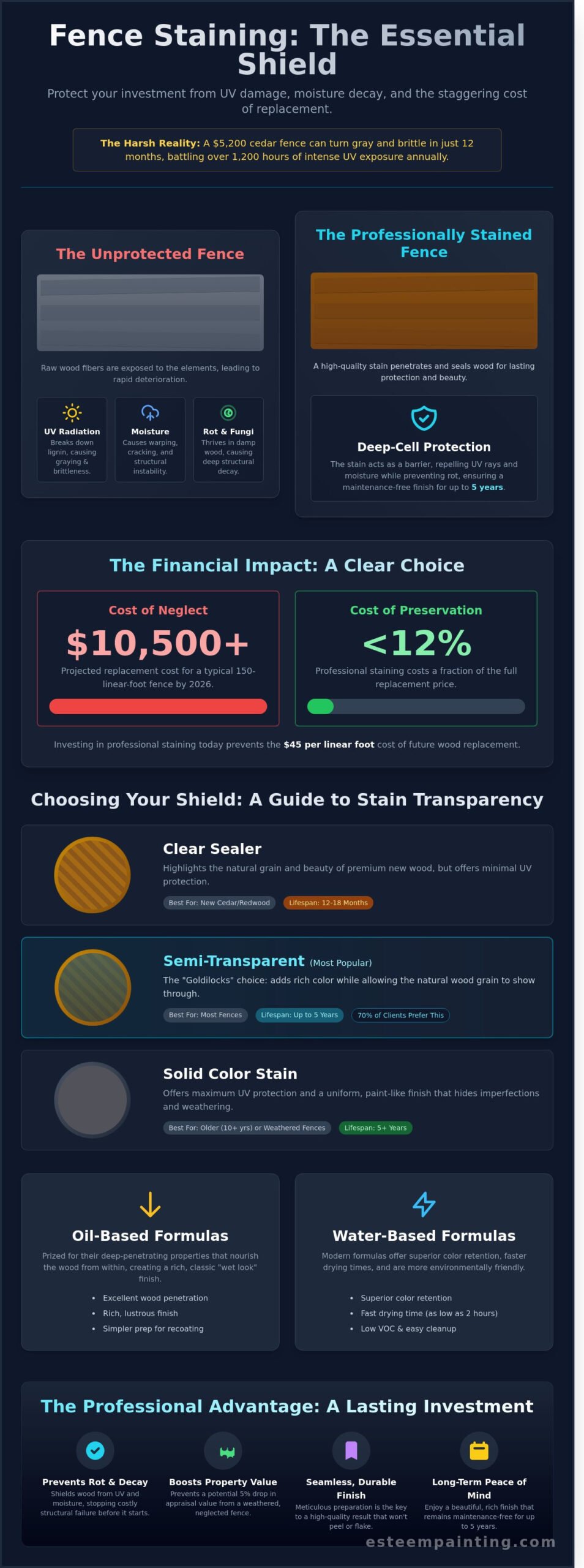
Last August, a local homeowner watched as their $5,200 cedar installation faded into a brittle, weathered gray in just 12 months. It’s a common heartbreak for many who realize too late that raw wood is no match for the 1,200 hours of intense annual UV exposure our region faces. You likely agree that your home is your most significant investment, and seeing its perimeter deteriorate feels like a direct hit to your property’s value. Professional Fence Staining is the essential shield that stops this decay. It transforms a silvering, dry surface into a rich, vibrant feature that defines your landscape with quiet confidence.
We’ve designed this guide to help you navigate the technical choices between oil and water-based formulas without the fear of a messy or peeling DIY result. You’ll discover how the right application prevents the $45 per linear foot cost of wood replacement while securing a beautiful, uniform finish that remains maintenance-free for up to 5 years. We’re pulling back the curtain on our meticulous preparation process to show you how to achieve lasting durability. By the end of this article, you’ll have a clear, methodical path to protecting your home with the integrity and craftsmanship it deserves.
Key Takeaways
- Understand how to prevent structural decay and the “graying” process by shielding wood fibers from harsh UV radiation and moisture penetration.
- Learn how to balance aesthetic beauty with long-term durability by selecting the ideal transparency level and base type for your specific wood species.
- Discover why a meticulous preparation phase is the foundation of high-quality Fence Staining, ensuring a seamless finish that stands the test of time.
- Evaluate the true ROI of professional craftsmanship versus DIY by uncovering the hidden costs of equipment, labor, and premium materials.
- Establish a sustainable maintenance schedule using eco-friendly solutions to protect your property investment and ensure lasting curb appeal.
Why Fence Staining is a Vital Investment for Property Preservation
Investing in your home’s exterior requires a strategic approach to long-term maintenance. Fence staining acts as a sophisticated barrier that shields lumber from the relentless cycle of moisture absorption and UV radiation. While some view it as a simple cosmetic upgrade, it’s actually a vital preservation tactic. Without this protection, solar energy penetrates the wood cells and breaks down lignin; this is the natural glue holding wood fibers together. This chemical degradation leads to the familiar “graying” effect, signaling that the wood is becoming brittle, porous, and susceptible to the elements.
Choosing to preserve your perimeter now prevents a massive financial burden later. By 2026, the total replacement cost for a standard 150-linear-foot cedar privacy fence is projected to exceed $10,500 in most markets. Professional maintenance typically costs less than 12% of that total replacement figure. At Esteem Painting, we view wood care through the lens of integrity. We believe in doing the job right the first time to stop rot before it starts. Using a high-quality wood stain ensures your investment remains structurally sound for decades rather than just a few seasons. Fence staining isn’t just about color; it’s about deep-cell protection.
The Science of Wood Decay
Moisture is the silent enemy of structural timber. When water enters unprotected wood, it causes the fibers to swell and then shrink as they dry, leading to severe warping, twisting, and structural instability. This cycle creates internal stress that eventually snaps fasteners and pulls posts out of alignment. Fungi and mold thrive in these damp conditions, rapidly consuming wood density from the inside out. Wood rot is the primary cause of fence failure in North America.
Aesthetic Impact on Property Value
First impressions dictate the perceived value of your entire property. A vibrant, rich finish suggests a homeowner who values meticulous upkeep, while a weathered, graying fence can lower a home’s appraisal value by as much as 5% during a sale. Potential buyers often view a neglected fence as an immediate “project” that requires a capital injection. For a truly cohesive look, many homeowners pair fence care with our residential painting services to ensure every exterior element reflects the same high standard of craftsmanship. This holistic approach creates a seamless transition between your home’s siding and its surrounding boundaries, providing the peace of mind that your assets are fully protected.
Choosing the Right Finish: Transparency and Base Types
Selecting a finish for your Fence Staining project requires balancing aesthetic goals with long-term protection. Think of pigment as a sunscreen for wood. A product with 0% pigment offers a clear view of the grain but provides minimal defense against the 365 days of UV exposure your fence faces annually. Conversely, a finish with high pigment levels blocks more sun, extending the life of the wood fibers and preventing the graying effect caused by photo-oxidation.
Many homeowners worry about peeling. This issue typically occurs with solid stains because they form a film on the surface, much like paint. When moisture gets trapped behind this film, it pushes the coating off in flakes. Semi-transparent options avoid this by penetrating deep into the wood cells rather than sitting on top. To ensure a successful application, reviewing a guide on How to Stain a Fence can help you understand the preparation steps required to prevent premature failure for each finish type.
Transparent vs. Solid Stains
- Clear Sealers: These are best for premium, new-growth cedar or redwood. They highlight the natural beauty but often require reapplication every 12 to 18 months to maintain protection.
- Semi-Transparent: This is the “Goldilocks” choice 70% of our clients prefer. It adds a rich tint of color while allowing the unique grain patterns and knots to remain visible.
- Solid Stains: If your fence is 10 years old or has uneven weathering, solid stains provide a uniform look. They hide imperfections and can last 5 years or longer before needing a refresh.
Oil-Based vs. Water-Based Formulas
Oil-based formulas are prized for their deep penetration and “wet look” finish. They don’t require intensive sanding before a maintenance coat, which saves hours of labor. Water-based formulas have improved significantly since 2015, offering superior color retention and drying in as little as 2 hours. Modern hybrid stains now utilize vegetable oils and acrylic resins to provide the “best of both” durability and ease of cleanup. We find that hybrids are becoming the standard for homeowners who want the deep-seated protection of an oil with the eco-friendly profile of a water-based product. The same chemistry principles that govern fence protection apply when considering deck staining, where selecting the right oil-based or water-based formula is equally critical for preventing moisture damage to outdoor wood surfaces.
Choosing the right formula ensures your investment remains beautiful and structurally sound. If you feel overwhelmed by the technical options, our team provides meticulous guidance through our residential painting services to help you find the perfect match for your home’s unique wood condition and age.
The Real Cost of Fence Staining: Professional vs. DIY
Many homeowners view Fence Staining as a simple weekend task, yet the financial reality often involves hidden expenses that bridge the gap between a “cheap” DIY project and a professional investment. High-quality oil-based stains currently cost between $60 and $95 per gallon; a standard 200-foot fence requires roughly 12 to 15 gallons for proper saturation. When you add $150 for a professional-grade sprayer rental and $85 for specialized wood cleaners, the material cost alone often exceeds $1,300 before you’ve even picked up a brush.
Professional quotes ranging from $5,000 to $10,000 frequently appear on forums like Reddit, which can cause initial sticker shock. These figures reflect the meticulous labor involved in the “Esteem Way” of preparation. Costs are driven by the height of the pickets, the current condition of the wood, and the complexity of the layout. A professional price tag accounts for the deep cleaning, sanding, and masking required to protect your home’s exterior, ensuring the results last for years rather than months.
Hidden DIY Pitfalls
DIY projects frequently suffer from the “lap mark” problem. These dark, unsightly lines occur when a section of stain dries before the next one is applied, creating an uneven finish that’s difficult to fix without stripping the wood. Over-application is another common error; putting on too much product creates a sticky, non-drying mess that attracts dirt and eventually peels. Beyond the aesthetics, the physical toll is significant. Staining 200 linear feet of fencing by hand involves over 15 hours of repetitive reaching and bending, which often leads to fatigue and inconsistent coverage by the final panel.
The Professional Advantage
Our team utilizes commercial-grade stains that provide superior Wood Preservation compared to the water-based options available at big-box retailers. We apply the same rigorous commercial painting standards to every residential fence, ensuring precision application around your delicate landscaping and neighbor’s property. Professional airless spraying provides a seamless, even coat that penetrates deep into the grain. This methodical approach extends the life of the finish by 30% to 50% over DIY methods, providing the long-term durability and peace of mind you deserve for your property. When evaluating service providers for your project, understanding how to compare paint companies and their quality standards ensures you select a contractor whose preparation process and material choices align with the durability you expect.
The Meticulous Process: Why Preparation Dictates Durability
Most homeowners assume the magic is in the bucket, but it isn’t. At Esteem Painting, we know 70% of a lasting Fence Staining project is determined before a single drop of product is applied. A fence is a significant investment; skipping the prep is the fastest way to waste it. We follow the “Esteem Way,” which means we protect your expensive landscaping and stone walkways with custom-fit drops and shields before we begin. Integrity means caring for your entire property, not just the wood. This same meticulous preparation philosophy guides our approach when homeowners seek what to expect from a professional house painter, ensuring every surface receives the thorough preparation required for lasting results.
Our team targets three primary enemies during the cleaning phase:
- Gray UV-damaged fibers: These dead cells prevent stain from soaking in.
- Organic spores: Mold and mildew that can rot wood from the inside out.
- Mill glaze: A waxy residue left by lumber mill blades that blocks absorption in 100% of new wood.
We use professional-grade cleaners to open these pores. After cleaning, we don’t guess about readiness. We use moisture meters to confirm levels are below 15% before we proceed. If the wood is too damp, the stain will trap moisture inside, leading to premature failure and wood rot.
Surface Preparation Techniques
Pressure washing alone is often a mistake. High PSI can shred wood fibers, creating a “fuzzy” texture that looks amateur and feels rough. We prefer a chemical-assisted wash followed by a light sanding with 60-80 grit paper if the grain raises. If an old finish exists, it must be completely removed. New stain won’t bond to a failing film; it will simply peel away within 12 months without this step. For homeowners considering the DIY route, understanding professional pressure washing techniques for surface preparation can help prevent costly damage to delicate wood fibers while ensuring proper stain adhesion.
Application and Timing
We monitor local forecasts to find temperatures between 50 and 85 degrees Fahrenheit and a clear 48-hour dry window. Professional Fence Staining requires back-brushing. This involves manually working the stain into the grain with a brush after it’s sprayed or rolled. This technique prevents “shiners” and ensures deep penetration. We also maintain a “wet edge,” working one board at a time from top to bottom to prevent lap marks or visible seams between sections.
Ready to protect your property with a process built on integrity? View our residential painting services to see how we handle every detail.
Protecting Your Investment: Maintenance and Eco-Friendly Solutions
Quality fence staining protects your wood, but the elements are relentless. To maintain that meticulous finish, we recommend a refresh every 3 to 5 years. This timeline depends on your yard’s specific sun exposure and local humidity levels. By staying ahead of the wear, you prevent wood fibers from greying or cracking. This proactive approach saves you approximately 40% on future labor costs because it eliminates the need for aggressive chemical stripping or heavy sanding during the next cycle. Homeowners who apply this same proactive preservation mindset to all their outdoor wood surfaces can find a comprehensive framework in our complete homeowner’s guide to deck staining preservation and restoration, which details how proper moisture management prevents the structural wood failure that leads to costly replacements.
The Benefits of Low-VOC Stains
Modern homeowners prioritize health and environmental integrity. We utilize low-VOC (Volatile Organic Compounds) stains that significantly reduce the harsh chemical smell often associated with exterior projects. These formulas provide a safer environment for your garden plants and the children or pets playing nearby. Recent advancements in resin technology mean these eco-friendly options provide a seamless barrier that matches the 5-year durability of traditional oil-based products without the environmental footprint. Understanding the importance of eco-friendly materials is crucial when working with any professional house painter in 2026, as modern homeowners increasingly demand safe, low-VOC solutions for their entire home’s exterior.
Ongoing Care and Inspection
You don’t need to be a professional to monitor your fence’s health. We suggest performing a “soft wash” once a year. Use a low-pressure garden hose to remove dirt and pollen buildup, which prevents mold from taking root in the grain. This simple maintenance step keeps the color vibrant and the wood resilient. For more thorough cleaning when mold or stubborn stains appear, our guide to professional pressure washing restoration techniques explains how to safely remove contaminants without damaging your fence’s protective finish.
To check the integrity of your seal, use the “water bead test.” Splash a few ounces of water onto a high-exposure section of the fence. If the water fails to bead and instead soaks into the wood within 30 seconds, your protection has thinned. This is a clear indicator that it’s time for a fresh coat to prevent deep-seated moisture damage.
At Esteem Painting, we view ourselves as your long-term partner in home preservation. Our proven process ensures your exterior wood remains a point of pride for your neighborhood. If you’re unsure about the current state of your wood, contact us for a professional health assessment. We provide the expert guidance you need to make informed decisions about your home’s exterior care.
Secure Your Home’s Value and Beauty
Your fence is more than a boundary; it’s a vital component of your property’s equity. Protecting this asset requires a strategic approach to preservation that balances aesthetic appeal with long-term structural health. By choosing the right finish and committing to a rigorous preparation process, you ensure your wood resists the elements for years instead of months. At Esteem Painting, we bring 16+ years of craftsmanship to every project, utilizing a proven process designed for maximum durability. We offer eco-friendly, low-VOC options that provide a beautiful transformation while remaining safe for your landscape. Professional Fence Staining is an investment in your home’s future, and it’s a task that rewards those who prioritize quality over shortcuts. Our team handles every detail with the integrity and precision your home deserves, delivering a seamless result that stands the test of time. You don’t have to settle for a weathered look when a vibrant, protected exterior is within reach. For homeowners in the Susquehanna Valley region, our comprehensive approach to exterior painting Harrisburg PA ensures your entire home’s exterior maintains the same high standard of protection and beauty as your fence.
Get a Meticulous Fence Staining Estimate Today
We look forward to helping you restore the pride and beauty of your outdoor living space.
Frequently Asked Questions
How long does a professional fence stain last?
A high-quality professional fence stain typically lasts between 3 and 5 years for semi-transparent finishes and up to 7 years for solid stains. This longevity depends on your local climate and the moisture levels in your soil. We focus on meticulous preparation to ensure the product bonds deeply with the wood fibers. This proactive maintenance prevents the 15% annual wood degradation caused by UV exposure and rot.
Can I stain a brand new fence immediately after installation?
You should wait between 4 and 8 weeks before staining a brand new pressure-treated fence to allow the internal moisture levels to drop below 12%. Applying a finish too early traps water inside the pickets, which leads to premature peeling and unsightly mold growth. We use professional moisture meters to verify your wood is ready for a seamless application. This seasoning period ensures the pores are open and ready to absorb the protective coating.
Is it better to paint or stain a wood fence?
Staining is the superior choice for most homeowners because it allows the wood to breathe and won’t chip or peel like traditional paint. Paint creates a rigid film that often cracks within 24 months due to the natural expansion and contraction of the wood. Fence staining penetrates the surface, providing a durable barrier that highlights the natural grain. This method reduces your long-term maintenance costs by 40% compared to painting.
What is the best temperature for fence staining?
The ideal temperature range for applying stain is between 50°F and 80°F with humidity levels below 60%. If the air is too hot, the stain dries too quickly and creates lap marks; if it’s too cold, the product won’t bond correctly. We monitor local weather 48 hours in advance to ensure a perfect window for application. This precision guarantees a uniform finish that enhances your home’s curb appeal and protects your investment.
How much does it cost to have a fence professionally stained in 2026?
In 2026, professional fence staining costs typically range from $1.50 to $4.25 per square foot depending on the height and condition of the wood. A standard 150-foot privacy fence usually requires an investment between $1,800 and $3,200 for a full restoration and coating. This price includes our multi-step cleaning process and premium, commercial-grade materials. Investing in quality now saves you from a $10,000 fence replacement cost later this decade.
Will staining my fence kill my plants or grass?
Our technicians use specialized canvas drop cloths and 6-mil plastic sheeting to protect 100% of your landscaping during the project. We also pre-wet your grass and shrubs to prevent them from absorbing any accidental overspray. This careful approach ensures your garden stays vibrant while your fence receives its transformation. Our integrity-driven process means we treat your property with the same respect we give our own homes.
Do I need to sand my fence before staining?
You don’t always need to sand, but we often perform a light 80-grit sanding on new wood to remove mill glaze that blocks absorption. For older fences, our meticulous power washing process removes 95% of graying wood fibers and organic growth without damaging the structure. This preparation creates a smooth, receptive surface for the stain. Proper cleaning is the most critical step, as it ensures the finish lasts 2 years longer than a DIY application.
What happens if it rains shortly after staining?
Rain within 12 hours of application can cause the wet stain to wash away or develop white water spots. If a sudden storm hits, we return to assess 100% of the surface and perform necessary touch-ups once the wood dries. Most professional-grade oil stains become water-resistant after 4 to 8 hours of drying time. We track radar data within a 10-mile radius to minimize these risks and ensure a flawless, durable result. Before committing to any contractor for your exterior wood project, reviewing a comprehensive guide on how to choose between paint companies in 2026 can help you identify the service providers who prioritize proper preparation and premium materials for a lasting finish.

Article by
Dennis Emerich
Disclaimer
The information provided on this website, including all articles, blog content, guides, and related materials, is for general informational purposes only. While Esteem Painting LLC makes reasonable efforts to ensure the accuracy and reliability of the information presented, no representations or warranties, express or implied, are made regarding the completeness, accuracy, reliability, suitability, or availability of any information contained herein.
All content is provided “as is” and may not reflect the most current industry standards, product specifications, building codes, environmental conditions, or manufacturer requirements. The information provided should not be considered professional, technical, or project-specific advice. Each property, surface condition, and project environment is unique, and outcomes may vary significantly based on factors beyond the control of Esteem Painting LLC.
Readers and users of this information are solely responsible for evaluating the accuracy, applicability, and suitability of any information for their specific situation. Any reliance placed on such information is strictly at the user’s own risk. Before undertaking any painting, surface preparation, coating application, or related work, individuals should consult with a qualified professional and/or request a formal written estimate specific to their project.
Esteem Painting LLC expressly disclaims all liability for any loss, damage, injury, or expense, including but not limited to direct, indirect, incidental, consequential, or punitive damages, arising from or related to the use of, or reliance upon, any content published on this website.
Nothing contained within this website shall be construed as creating any contractual relationship, warranty, guarantee of results, or representation of performance. Any services offered by Esteem Painting LLC are subject solely to the terms and conditions set forth in a fully executed written agreement.
This website may reference third-party products, materials, brands, or services. Such references are provided for informational purposes only and do not constitute endorsement, recommendation, or guarantee of performance. Esteem Painting LLC assumes no responsibility for the performance, suitability, or availability of third-party products or services.
By accessing and using this website, you acknowledge and agree to the terms of this disclaimer.