
When you ask yourself should you paint brick, you aren’t just choosing a new color; you’re making a permanent decision that affects the structural health of your home. It’s a heavy choice, especially when you’re caught between the desire to hide outdated 1970s orange tones and the fear of "spalling," where trapped moisture causes the brick face to crumble. You deserve a modern exterior that doesn’t come with a $12,000 repair bill or the anxiety of a "point of no return" mistake.
At Esteem Painting, we believe in craftsmanship rooted in transparency and long-term value. This guide provides the technical clarity you need to move forward with confidence. You’ll discover the specific risks of traditional coatings, the aesthetic rewards of a professional transformation, and why 4 out of 5 masonry experts now recommend breathable alternatives like mineral staining or limewashing. We’re here to show you the "Esteem Way" of protecting your most valuable asset while achieving the beautiful, polished look your home deserves.
Key Takeaways
-
Understand the "Tattoo Effect" and why this aesthetic transformation is a permanent decision that requires a meticulous approach.
-
Discover the critical science of vapor permeability to ensure your brick can "exhale" moisture and maintain its long-term durability.
-
Evaluate the technical differences between traditional paint, mineral stains, and limewash to help you decide whether you should paint brick or opt for a more breathable alternative.
-
Learn how to conduct a professional assessment of your masonry’s health, including the essential "water test" for surface absorption.
-
Gain peace of mind by following a proven, multi-step preparation process designed to deliver a beautiful result that honors your home’s integrity.
Table of Contents
The Painted Brick Dilemma: Why It’s a Permanent Decision
Walk through any established neighborhood in Pennsylvania and you’ll see the trend. The crisp, uniform look of white or charcoal painted brick has become a staple of modern farmhouse design. It offers an immediate, high-impact transformation that can make a 1980s colonial feel like a contemporary estate. However, deciding if should you paint brick requires a deep understanding of the long-term commitment you’re making to your home’s exterior.
Think of painting brick as getting a tattoo for your house. Brick is a naturally porous material, filled with millions of microscopic pathways. Once paint seeps into these pores, complete removal becomes nearly impossible. Traditional sandblasting or chemical stripping often destroys the brick’s face, leaving it scarred and vulnerable. You are moving from a surface that requires zero maintenance for 100 years to one that enters a 5 to 10 year maintenance cycle. This shift requires a disciplined approach to upkeep to ensure your home’s curb appeal doesn’t fade into peeling paint and trapped moisture.
At Esteem Painting, we believe in craftsmanship that lasts. That’s why we emphasize the technical side of the process. Standard latex paints often fail on masonry because they trap water vapor. For a successful application, we look toward specialized solutions. Silicate mineral paints are an excellent choice because they form a chemical bond with the brick rather than just sitting on top. This creates a breathable surface that allows moisture to escape, preserving the integrity of the wall while providing a beautiful, flat finish.
Modern vs. Historic Brick: The Stakes are Different
The age of your home dictates the risk level. Historic bricks produced before 1940 were often handmade and fired at lower temperatures, resulting in a soft, highly absorbent core. Painting these can be disastrous, as trapped moisture freezes and expands, causing the brick face to pop off. Modern bricks are kiln-fired at temperatures exceeding 2,000 degrees Fahrenheit. This creates a vitrified, "hard-fired" outer shell that is much more resilient. If your home was built in 1990, it can likely handle paint; if it was built in 1910, you should proceed with extreme caution.
The Interior Exception: Fireplaces and Accent Walls
If you’re hesitant about the exterior, interior brick offers a stress-free alternative. Fireplaces and interior accent walls aren’t subject to Pennsylvania’s brutal freeze-thaw cycles, making them much safer to paint. A dated 1970s red-brick fireplace can be modernized in a single weekend. We recommend using a durable satin or semi-gloss finish for these areas. This makes it much easier to wipe away soot or dust, ensuring your living room remains a polished, inviting space for years to come.
The Science of Porosity: Understanding Vapor Permeability
Brick is a naturally porous material that acts much like a sponge, absorbing and releasing moisture to maintain its structural balance. When you ask yourself if you should you paint brick, you must consider how a coating affects this breathing process. Standard latex or oil-based paints often create a plastic-like vapor barrier on the surface. This film seals the pores of the masonry, preventing internal moisture from escaping. While a fresh coat of paint looks clean, it can trap gallons of water within your walls, leading to hidden decay that compromises your home’s durability.
What is Vapor Permeability?
Vapor permeability is the rate at which water vapor passes through a material. In the painting industry, we measure this using a "perm rating." High-quality masonry coatings require a high perm rating to ensure the wall doesn’t hold onto dampness. When permeability is restricted, moisture accumulates in the wall cavity, which can trigger mold growth in as little as 48 hours. The NPS Preservation Brief on Masonry Treatments highlights that preserving this natural moisture flow is the most critical factor in preventing long-term masonry failure.
The Dangers of Trapped Moisture
Pennsylvania weather presents a specific challenge for painted brick. Our region typically experiences 40 to 60 freeze-thaw cycles every winter. When water gets trapped behind a non-breathable paint film and freezes, it expands by approximately 9% in volume. This creates immense internal pressure that leads to "spalling."
-
Spalling: This occurs when the outer face of the brick literally pops off because the trapped ice has nowhere to expand.
-
Mortar Degradation: Moisture also attacks the mortar joints, which comprise roughly 15% of your exterior wall surface. Softened mortar leads to loose bricks and water intrusion.
-
Efflorescence: As water moves through the brick, it carries natural salts to the surface. These salts crystallize behind the paint, creating enough force to peel the coating away in large flakes.
This damage isn’t just an aesthetic issue; it’s a threat to the structural integrity of your home’s envelope. Understanding these mechanical risks is the first step toward a successful transformation. The same principles of proper moisture management that protect brick also apply to other exterior wood surfaces — proper deck staining and wood preservation relies on breathable coatings that allow moisture to escape rather than become trapped. Our proven masonry evaluation identifies these moisture levels early to ensure your home remains both beautiful and breathable for years to come. By choosing the right materials, you protect the craftsmanship of your home while achieving the modern look you desire.
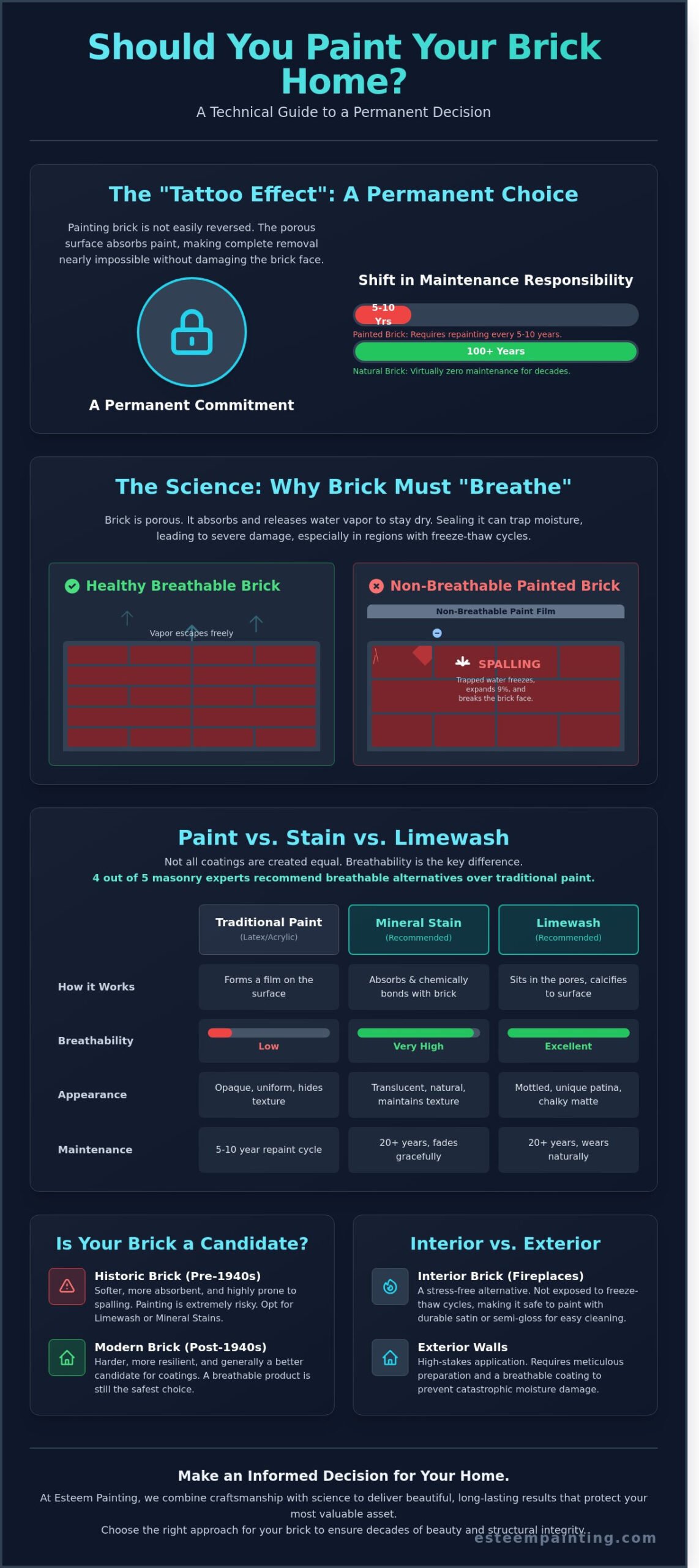
Paint vs. Stain vs. Limewash: Choosing Your Coating
Deciding how you should you paint brick requires a clear understanding of how different materials interact with masonry. Traditional latex or acrylic masonry paint provides a high-coverage, uniform look. However, it creates a non-breathable film that traps moisture inside the brick. In Pennsylvania, where we face roughly 40 freeze-thaw cycles annually, this trapped water expands and leads to peeling or "spalling" within 5 to 7 years. Our team views this as a short-term fix that often creates long-term maintenance headaches.
-
Traditional Paint: High opacity but carries the highest risk for moisture damage.
-
Mineral Stains: These chemically bond to the brick, maintaining 100% breathability.
-
Limewash: A classic mixture of crushed limestone and water for a weathered, matte aesthetic.
-
German Smear: A technique using wet mortar to add heavy texture and varied color.
Why Mineral Stains are the Professional Choice
We recommend mineral stains for homeowners who value durability and integrity. These coatings don’t sit on the surface; they soak into the brick’s pores to become part of the structure. A meticulous application of mineral stain preserves the natural texture of your masonry while offering a lifespan of 20 to 30 years. Compared to the 6-year average lifespan of standard paint, stains provide significantly better long-term value and peace of mind. You get a fresh look without sacrificing the brick’s ability to release vapor. It’s the "Esteem Way" of ensuring your home’s exterior remains healthy for decades. The same philosophy behind choosing the right stain for masonry applies when selecting coatings for other outdoor surfaces — our guide to deck staining preservation and restoration explores how premium penetrating stains outperform film-forming coatings for long-term wood protection. When evaluating your options, understanding how to compare paint companies and their product systems can help you identify contractors who prioritize breathable, high-performance coatings over entry-level alternatives.
The Aesthetic of Limewash and German Smear
If you prefer a distressed or "Old World" look, limewash is an excellent eco-friendly option. Products like Romabio limewash are naturally antimicrobial, meaning they resist the algae and mold common in humid PA summers. You can choose a solid finish or have our craftsmen wash away portions of the coating for a weathered effect. German smear offers even more drama by using mortar to create a heavy, uneven texture. This method is permanent and doesn’t require the same maintenance as painted surfaces, making it a robust choice for a total home transformation. When you’re asking if you should you paint brick, consider if these textured, breathable finishes better suit your home’s architectural character.
The Professional Assessment: Is Your Brick a Candidate for Paint?
Before reaching for a brush, we have to determine if your home’s exterior is actually ready for a coating. Not every masonry surface is a healthy candidate for a new finish. When asking yourself should you paint brick, the answer depends entirely on the current health of the masonry and the presence of moisture. We look for specific red flags during our initial walk-through, such as rising damp, which is moisture pulled from the ground into the bottom three courses of brick. If we find crumbling mortar or structural cracks wider than 2 millimeters, these must be addressed to prevent total coating failure.
The presence of efflorescence is perhaps the most critical "stop" sign we encounter. These white, powdery salt deposits indicate that water is moving through the brick and evaporating on the surface. If you apply paint over efflorescence, the salt pressure will push the paint film off the wall in as little as 6 to 12 months. We also evaluate the wall’s environment; a north-facing wall in a permanent shadow requires a different preparation strategy than a sun-drenched facade to prevent mildew growth.
Conducting the Absorption Test
The "Esteem Way" begins with a simple on-site absorption test to help evaluate how your brick will respond to a coating system.
We apply a light mist of water to multiple areas of the surface and observe how it behaves. If water beads or remains on the surface, it may indicate the presence of a prior sealer, which can affect coating adhesion and may require additional preparation.
If the water absorbs into the masonry, it indicates an open, porous surface that is generally more receptive to breathable coating systems.
This initial assessment helps us determine the appropriate preparation and product system to ensure proper adhesion and long-term performance.
Pre-Painting Repairs and Prep
Preparation is where craftsmanship and long-term performance come together.
Excessive pressure washing can damage masonry by eroding the surface and weakening mortar joints. For this reason, we use a controlled low-pressure cleaning process to safely remove contaminants without compromising the substrate.
After cleaning, we allow the masonry to dry based on site conditions and verify moisture levels using professional-grade meters. This helps ensure the surface is within an acceptable range for proper coating adhesion before any application begins.
If deteriorated mortar joints are identified, we recommend tuck-pointing to restore the condition of the masonry and provide a stable, uniform surface for proper coating adhesion and long-term performance.
This disciplined preparation process is critical to achieving a durable, long-lasting finish.
Ready to find out if your masonry is ready for a change? Schedule a professional assessment to see if your home is a candidate for a premium brick transformation.
The Esteem Way: Meticulous Preparation for Lasting Results
Deciding if you should paint brick involves more than picking a color. It requires a deep understanding of how porous materials react to Pennsylvania’s volatile climate. At Esteem Painting, we’ve spent 16 years refining a process that balances aesthetic beauty with structural health. We prioritize vapor-permeable, low-VOC coatings because they allow moisture to escape from the masonry. This prevents the internal rot and surface peeling that occur when standard, non-breathable paints trap water inside the brick. When you’re weighing the question of whether you should paint brick, remember that the preparation dictates the lifespan of the project.
Our multi-step preparation process is designed to handle the specific challenges of PA homes, from high humidity to freezing winters. We follow a strict protocol to ensure your home survives the local climate:
-
Deep Cleaning: We remove dirt, mildew, and efflorescence using professional pressure washing techniques that won’t degrade the mortar.
-
Structural Repairs: Our team inspects the brickwork for cracks or failing joints, ensuring the surface is sound before any coating is applied.
-
Precision Priming: We use high-bond primers specifically engineered for high-pH surfaces.
Integrity in Every Layer
Material selection matters. Exterior masonry requires coatings that can handle temperature shifts, surface movement, and the natural alkalinity of brick.
That’s why we use high-performance coating systems engineered for long-term adhesion and durability — not entry-level products that are more prone to early failure.
Just as important is how we protect your property. We use professional-grade coverings and precision masking to minimize risk and keep surrounding surfaces protected throughout the process.
Our philosophy is simple: do it right the first time, so you don’t have to do it again.
Transforming Your Home with Confidence
Choosing the right sheen is a critical design decision. While high-gloss finishes highlight every imperfection, we typically recommend flat or matte sheens for masonry. These finishes provide a sophisticated, modern look that mimics the natural texture of the stone while hiding minor flaws. A professional transformation adds significant curb appeal and long-term value to your asset. We handle every detail, from the initial estimate to the final walkthrough, to ensure your experience is entirely stress-free. If you’re ready to see what’s possible, schedule a professional consultation with Esteem Painting today.
Secure Your Home’s Future with a Professional Transformation
Deciding should you paint brick is a significant choice that shapes your home’s character for decades. We’ve explored why understanding vapor permeability is vital for masonry health and how selecting the correct coating, whether it’s a breathable paint or a mineral stain, dictates long-term durability. It’s about doing things the right way, not the easy way. At Esteem Painting, we bring over 16 years of local Pennsylvania expertise to every project. We specialize in low-VOC, eco-friendly coatings that protect both your family and the local environment. Our 5-star rated craftsmanship ensures your brick isn’t just covered; it’s meticulously preserved through our proven process. We take the stress out of home improvement by leading with integrity and technical precision. You deserve a home that reflects your pride of ownership. Let’s ensure your brick transformation is seamless, beautiful, and built to last. Whether you’re considering brick painting or comprehensive exterior painting in Harrisburg PA, our team is ready to provide the expert guidance your property requires. Understanding what to expect from a professional house painter ensures your project runs smoothly from start to finish.
Get a Meticulous Quote for Your Brick Transformation
We look forward to bringing your vision to life with the care it deserves.
Frequently Asked Questions
Is it a bad idea to paint exterior brick?
Painting exterior brick can be an effective way to modernize a home when the correct masonry coating system is used and the substrate is properly prepared.
The key is selecting breathable coatings designed for masonry. When inappropriate products are used or moisture is present within the substrate, coatings can restrict vapor movement, which may contribute to issues such as spalling or surface deterioration over time.
When homeowners consider painting brick, we evaluate the condition of the masonry, moisture levels, and overall exposure to determine the appropriate system. Our preparation process is designed to support long-term performance while enhancing the appearance of your Pennsylvania home..
How long does painted brick last before it starts peeling?
When applied correctly, a professional masonry coating system can last for many years before requiring maintenance, depending on the condition of the brick and environmental exposure.
Most premature failures aren’t caused by the paint itself — they’re caused by improper preparation, including moisture in the substrate or untreated surface contaminants like efflorescence.
That’s why we follow a structured process that includes controlled cleaning, surface conditioning, and moisture verification before any coating is applied. This ensures proper adhesion and long-term durability — not just a short-term cosmetic result.
Can you change your mind and remove paint from brick later?
Removing paint from brick is a labor-intensive process that can cost $10 to $15 per square foot. Chemical stripping or sandblasting often damages the protective fire skin of the brick, which increases water absorption by 40%. We recommend treating this as a permanent design choice; once the transformation is complete, maintaining the color is far more cost-effective than attempting a full restoration.
Does painting brick decrease the resale value of a home?
A professional exterior refresh typically increases home value by 5% to 7% by boosting curb appeal. Data from the National Association of Realtors suggests that updated white or charcoal brick homes often sell 12 days faster than those with dated, multi-colored brick. This aesthetic upgrade provides immediate peace of mind and creates a sense of pride that modern buyers prioritize during their home search.
What is the best type of paint to use on a brick fireplace?
Painting a brick fireplace requires more than just standard paint — it requires the correct system based on heat exposure.
For the fireplace surround, we use a professional masonry coating system that includes proper surface preparation, a high-performance bonding primer, and a durable acrylic finish designed for long-term adhesion.
Any areas exposed to direct flame or extreme heat are treated separately with specialty high-temperature coatings, as standard products are not designed for those conditions.
When properly applied and maintained, this system provides a clean, seamless finish designed to resist peeling, flaking, and premature wear over time.
What is the difference between brick paint and brick stain?
Brick paint and brick stain serve very different purposes, and choosing the right system depends on the condition of the masonry and the desired result.
Brick paint creates a uniform, opaque coating that sits on the surface, allowing for full color transformation and the ability to conceal variations in the brick and mortar.
Brick stain, on the other hand, penetrates into the surface of the masonry, enhancing the natural texture while maintaining higher vapor permeability and a more natural appearance. Because it absorbs into the substrate, it will not peel like traditional coatings.
When homeowners ask whether to paint or stain brick, we evaluate factors such as surface condition, prior coatings, and moisture levels to determine which system will perform best long-term.
How much does it cost to have a professional paint a brick house?
Painting a brick home is not the same as painting siding — it requires a properly engineered masonry coating system to protect the structure long-term.
For a professional application done correctly, most projects range from $6.00 to $12.00+ per square foot, or approximately $12,000 to $20,000+ for a 2,500-square-foot home, depending on prep requirements and surface condition.
This includes a multi-step preparation process, proper masonry conditioning, and the use of breathable coatings designed specifically for brick. Cutting corners on this type of project often leads to moisture entrapment and failure — issues that can exceed $20,000+ in remediation costs. Working with an experienced professional house painter who understands masonry systems ensures your investment is protected through proper preparation and material selection.
Do I need to prime brick before painting it?
Brick isn’t just another surface — it’s a living material that constantly exchanges moisture and retains natural alkalinity.
Applying standard paint without the proper masonry system can lead to early failure, including peeling, chalking, and trapped moisture within the substrate.
That’s why we use a dedicated masonry coating system, starting with a high-alkali-resistant primer and finishing with breathable coatings engineered for brick. This approach ensures proper adhesion, durability, and long-term performance — not just a temporary cosmetic upgrade.
Article by
Dennis Emerich
Disclaimer
The information provided on this website, including all articles, blog content, guides, and related materials, is for general informational purposes only. While Esteem Painting LLC makes reasonable efforts to ensure the accuracy and reliability of the information presented, no representations or warranties, express or implied, are made regarding the completeness, accuracy, reliability, suitability, or availability of any information contained herein.
All content is provided “as is” and may not reflect the most current industry standards, product specifications, building codes, environmental conditions, or manufacturer requirements. The information provided should not be considered professional, technical, or project-specific advice. Each property, surface condition, and project environment is unique, and outcomes may vary significantly based on factors beyond the control of Esteem Painting LLC.
Readers and users of this information are solely responsible for evaluating the accuracy, applicability, and suitability of any information for their specific situation. Any reliance placed on such information is strictly at the user’s own risk. Before undertaking any painting, surface preparation, coating application, or related work, individuals should consult with a qualified professional and/or request a formal written estimate specific to their project.
Esteem Painting LLC expressly disclaims all liability for any loss, damage, injury, or expense, including but not limited to direct, indirect, incidental, consequential, or punitive damages, arising from or related to the use of, or reliance upon, any content published on this website.
Nothing contained within this website shall be construed as creating any contractual relationship, warranty, guarantee of results, or representation of performance. Any services offered by Esteem Painting LLC are subject solely to the terms and conditions set forth in a fully executed written agreement.
This website may reference third-party products, materials, brands, or services. Such references are provided for informational purposes only and do not constitute endorsement, recommendation, or guarantee of performance. Esteem Painting LLC assumes no responsibility for the performance, suitability, or availability of third-party products or services.
By accessing and using this website, you acknowledge and agree to the terms of this disclaimer.
Pingback: Is Tile and Grout Resealing Worth It? A Geelong Homeowner’s Guide to Resealing - JJs Carpet & Tile Cleaning
Pingback: Reviews for Cabinet Painters in Boulder: How to Hire a True Specialist | Cabinet Refinishing and Kitchen Cabinet Painting Boulder Co. 303-591-2089